Kelly
The horse carried her healing further than medicine alone.
My oldest daughter, Kelly, grew up happy, bright, and capable – homeschooled on a small hobby farm in North Carolina, surrounded by horses, and living a full life. Most people around her would have never guessed she lived and struggled with autism. She was funny. She had opinions. And she lived life on her own terms.
For years, life was good. Kelly thrived in the structure of home education. She had horses nearby, animals to care for, and the kind of routine that autistic children often need and rarely get. Then we moved to New Hampshire. The farm and horses stayed behind. My new position kept me away from home more than any of us had expected. The anchors that had held her steady were disappearing one by one, and we didn’t see the result of those losses until much later.
Puberty arrived and things began to change – slowly, subtly, in ways that were easy to attribute to adolescence or to autism and leave it at that. A gradual dimming and narrowing of her engagement with the world. We adjusted. We accommodated. We told ourselves it was a phase. On Valentine’s Day, 2024, at seventeen years old, we finally saw the destination of that path. She slept all day and never got out of bed. We attributed it to fatigue from a minor illness.
As February moved into March we watched our daughter deteriorate before our eyes. There were days she would grab her head and scream in terror, crying out that she was broken. When she started hallucinating, I drove her to the emergency room. It was the first of many hospital visits. What followed took a team of specialists months to diagnose. She was in the hospital for six weeks, long enough that we missed our usual Easter celebration. We had arrived at our darkest hour without ever seeing the path that had brought us there.
Autistic catatonia is a severe condition that most doctors – even good ones – have never seen before. It happens when catatonia, a disorder that affects a person’s ability to move and respond, develops in someone who already has autism. The two conditions look similar enough that each one can hide the other. That is why it takes so long to diagnose. By the time a family gets an answer, they have usually already been told a dozen things it isn’t. We were first told Kelly was just a little dehydrated, and later, when things got worse, that she likely had schizophrenia.
Most people have at least heard of autism. Fewer people know what catatonia is. Historically it was commonly called sleeping beauty disease – a very appropriate name. A person with catatonia can become so disconnected from their own body that they stop moving, stop speaking, stop responding to the world around them, and literally sleep their life away. Before modern treatment existed, the most severe cases killed more than half of its victims – because they stopped eating, stopped drinking, and stopped functioning entirely. They may freeze mid-action. They may stare without blinking. They may be awake but completely unreachable. It is not a voluntary behavior. It is the brain losing its ability to communicate with the body and execute even the most basic of bodily functions. In its most severe form it is a medical emergency, and it is terrifying to watch happen to someone you love.
For a rare condition, it is more common than most people think. Somewhere between one in ten and one in five autistic people will experience it at some point in their lives. It is still widely missed, often dismissed, and frequently under-treated. If you are reading this because something is happening to your child or loved one that no one can explain, this may be worth looking into.
Autism affects a part of the brain called the cerebellum. Two review papers on the neuroscience of autism both point to the cerebellum as one of the most consistent sites of abnormality in autism spectrum disorder – the same region tied to movement, language, and social processing. A systematic review of brain-imaging studies in catatonia found the cerebellum among the regions showing consistent abnormalities, alongside the areas that control movement. The cerebellum has even been implicated in catatonia itself.D’Mello & Stoodley, 2015 · Hampson & Blatt, 2015
Think of the cerebellum as the brain’s traffic control center. It keeps brain activity flowing smoothly instead of backing up and creating a traffic jam. It helps with movement, balance, speech, and the ability to take in the world without being overwhelmed by it. In both autism and catatonia, the cerebellum is smaller than usual or not working the way it should.Cattarinussi et al., 2024
This condition is difficult to identify and it can take years to get the right diagnosis. It should not take that long. The sooner autistic catatonia is recognized, the sooner the right kind of help can begin. There is hope. For a long time, doctors believed that once the brain was damaged or developed abnormally, that was that. Nothing could change it. We now know that is not true. The brain can be changed. It can grow, adapt, and regain function when given the right kind of input. For more on the neuroscience of brain repair see the Articles page.
Before Kelly’s hospitalization, we were working through formal autism testing since we were becoming more convinced that autism was at the center of Kelly’s health issues. During this time, we enrolled her in a certified therapeutic riding program nearby in the hopes that it might help with her list of issues that had been steadily growing for years. During a brief respite from the hospital, we were able to take her for some therapeutic riding once more. We knew something was still seriously off because each time Kelly came to the barn was like her first time there. She didn’t remember her instructor. She didn’t remember the horse. She had no connection to what had happened before. She was present in body but absent in every other way.
After discharge, the hospital visits didn’t stop. Kelly was traveling to Dartmouth regularly for electroconvulsive therapy (ECT) – a treatment that can interrupt catatonic episodes but also carries memory loss as a potential side effect. For Kelly, that potential became very real. At Christmas we realized she had forgotten her extended family – aunts, uncles, grandparents, close family friends she didn’t see every day. Then the losses became smaller and somehow more heartbreaking. She forgot which kitchen drawer held the spoons. She forgot where the bowls went when helping put away the dishes. She forgot her favorite movies. We re-watched many of them together, and each time it was like seeing her watch them for the very first time all over again. ECT kept her alive. It also kept resetting her like pressing the reboot button on a computer, starting life all over again.
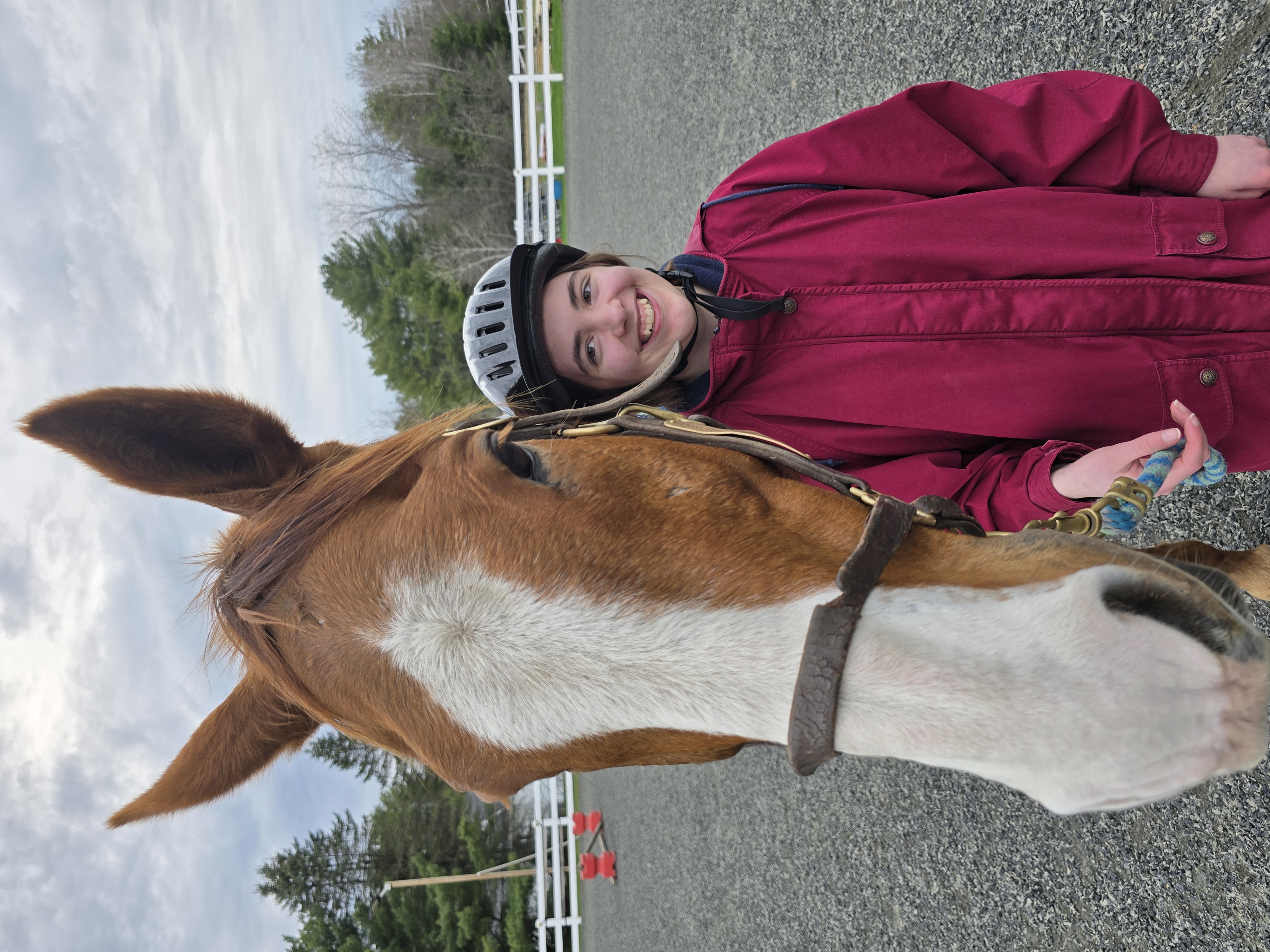
During this time, a friend living near the hospital offered to let Kelly ride her horse Leo, a semi-retired racehorse with a big heart. Without thinking, I returned to my classical roots, and started guiding Leo through some basic dressage work while Kelly sat in the saddle. I was simply trying to keep Kelly from getting bored while riding since she had a hard enough time just getting into the saddle. We repeated the routine week after week with no expectations. But something was different. Things began changing for Kelly. She started to be more vocal, and talked more after each ride. And even though ECT was constantly erasing pieces of her memory, she remembered Leo.
Over the following months, Kelly’s body began waking up in other ways. The rigidity of catatonia began to soften. Her ability to move, to respond, and be present in her own body started returning. The medical interventions required to keep her alive and functioning decreased as her time in the saddle increased. For an entire year, we drove two hours each way to work with Leo.
At the end of 2025, an opportunity presented itself. We needed a horse, and one of Leo’s pasture mates needed a home. Ruby came to us as a gift that changed everything. At the same time an open slot for horse board became available at a facility close to home. Having Ruby live so close to home meant daily sessions instead of a four-hour drive once a week. And with daily repetition, Kelly’s Neuro-Rehab could advance further and hopefully provide greater progress.
Now, two years after catatonia hospitalized her, Kelly is mobile, more interactive, and becoming a little more independent. We are not out of the woods yet. But we have hope that the end might soon come into view.
The horse is the chrysalis. What mounts is a caterpillar. What dismounts is a butterfly. From this hidden work emerges what neither horse nor rider could have made alone.
Kelly’s story is not finished. Her condition is stable, but that stability is fragile. She works with Ruby four or five days a week. Some days the progress is immediate and obvious. Some days there seems to be no effect, though we wonder if the work prevented a worsening that might have happened without it.
In the beginning, my goal was to simply keep my daughter alive and functioning. She always loved horses, and letting her sit on a horse seemed like the only thing we could do for her. Leo helped us accomplish that very important goal. Now my goal is to give Kelly a functional and independent life of her own. Ruby is helping her with this goal. We enjoy the good days and pray hard for a reduction in bad days. Our work still continues every day in the arena with Ruby. If you want to follow along, I am documenting what we do, what works, and what can be better. You can find it inside my journal, Recovering with Ruby.
If your family is navigating autism, catatonia, or a neurodevelopmental condition and you are wondering whether this work might change the direction of your story, please reach out.